Text from this article: http://blogs.smithsonianmag.com/dinosaur/2011/02/flowers-pine-cones-and-dinosaurs/?utm_source=feedburner&utm_medium=feed&utm_campaign=Feed%3A+smithsonianmag%2FDinosaur+%28Dinosaur+Tracking%29&utm_content=Google+Reader
When we think about the Mesozoic world, dinosaurs often dominate our attention. They are the stars of countless museum displays and restorations, and everything else about their world just seems like window dressing. When visitors to Yale’s Peabody Museum look at Rudolph Zallinger’s beautiful (if outdated) “Age of Reptiles” mural, their attention is drawn to the tubby Allosaurus and the “Brontosaurus” wallowing in the swamp. The plants and animals Zallinger painted around the dinosaurs simply provide the setting for the more charismatic monsters.
But as with modern ecosystems, we can’t fully understand the lives of dinosaurs without knowing something about the supporting cast of organisms they lived alongside, especially plants. After all, plants were food to many, many dinosaur species, and plants undoubtedly influenced the evolution of dinosaurs just as dinosaurs influenced the evolution of plants. In fact, in a 1978 Nature paper, paleontologist Robert Bakker went so far as to suggest that dinosaurs had “invented” flowers.
Bakker’s reasoning went like this. During the Jurassic and Early Cretaceous many of the large herbivorous dinosaurs—especially the stegosaurs and sauropods—fed on plants like cycads and conifers. Given the size of these dinosaurs, they would have consumed massive amounts of plant food, and their preferences at the prehistoric salad bar opened up opportunities for fast-growing plants that were able to quickly grow in disturbed environments—namely, the angiosperms, which include flowering plants. Dinosaurs effectively cleared away the competition and allowed flowering plants to proliferate, and in turn, the changes in the plant communities influenced the evolution of dinosaurs with heavy batteries of chewing power, such as the hadrosaurs and horned dinosaurs.
It is a lovely idea—we can thank dinosaurs for flowers—but studies conducted during the past 30 years have scrapped the hypothesis. Better sampling of the dinosaur and flowering plant fossil records caused the correlation between the two to fall apart. There is no strong evidence that dinosaurs had anything to do with the origin or initial spread of flowers. Many dinosaurs ate angiosperms at the end of the Cretaceous, but that is about all we know for sure about their relationship.
Nevertheless, dinosaurs probably did have some effect on plant evolution. Think of herbivorous dinosaurs as plant predators. Unlike animals, plants can’t run away or otherwise evade their attackers, and so many plants have evolved defenses to discourage animals from eating them. Burning oils, toxic chemicals, thorns, microscopic spicules of silica and more—for plants, it’s war, and a paper published this week suggests that sauropod dinosaurs may have influenced the evolution of one plant defense.
Published by Andrew Leslie in the Proceedings of the Royal Society B, the study looked at changes in the anatomy of conifer cones over the past 300 million years. Among the trends Leslie noticed was that seed-containing cones began increasing the amount of protective tissue around their seeds during the middle of the Jurassic. In particular, a group of trees technically known as the Araucariaceae and popularly called monkey puzzles was among the first conifers to develop large, well-protected cones, and these trees have been cited as an important food source for the large sauropod dinosaurs that proliferated during this time. Perhaps, Leslie suggests, the feeding habits of the large, long-necked dinosaurs of the Jurassic provided the evolutionary pressure for the development of well-protected seed cones.
But dinosaurs were not the only plant predators around. Early birds and small mammals may have fed on the seeds of conifers and been even more important to the evolution of well-armored cones, Leslie noted, and the diversification of insects with powerful piercing, sucking and chewing mouth parts during the Jurassic probably played a role in seed cone changes, as well. Many animals, both large and small, fed on various parts of conifer trees, but figuring out the exact details of these interactions is extremely difficult from our current vantage point.
References:
Bakker, R. (1978). Dinosaur feeding behaviour and the origin of flowering plants Nature, 274 (5672), 661-663 DOI: 10.1038/274661a0
BARRETT, P., & WILLIS, K. (2001). Did dinosaurs invent flowers? Dinosaur–angiosperm coevolution revisited Biological Reviews of the Cambridge Philosophical Society, 76 (3), 411-447 DOI: 10.1017/S1464793101005735
Hummel, J., Gee, C., Sudekum, K., Sander, P., Nogge, G., & Clauss, M. (2008). In vitro digestibility of fern and gymnosperm foliage: implications for sauropod feeding ecology and diet selection Proceedings of the Royal Society B: Biological Sciences, 275 (1638), 1015-1021 DOI: 10.1098/rspb.2007.1728
Leslie, A. (2011). Predation and protection in the macroevolutionary history of conifer cones Proceedings of the Royal Society B: Biological Sciences DOI: 10.1098/rspb.2010.2648
Monday, February 28, 2011

Thursday, January 13, 2011
Stygimoloch vs. Pachycephalosaurus


The Stygimoloch is on the left, the Pachycephalosaurus is on the right. Thanks to Dinosaur Train, Des was introduced to the Stygimoloch first. Now whenever he sees a Pachycephalosaurus, he calls it a Stygimoloch and doesn't believe me when I tell him the truth.
This entry is to show Des the truth. To give Des credit, these two dinosaurs have more similarities than differences.
Similarities:
Both lived during the late Cretaceous period.
Remains of both were found in Montana and Wyoming in North America.
Both were probably herbivores.
Both were boneheaded dinosaurs.
Both were in the dinosaur class Pachycephalosauria.
Differences
Stygimoloch had sharp spikes around his bonehead, while Pachycephalosaurus had bump-like studs around his bonehead.
Stygimoloch was significantly smaller. At 9 feet, he probably weighed about 190 pounds.
Pachycephalosaurus was 16 feet, and weighed about 1100 pounds.
Stygimoloch (pronounced Stij-ee-moll-ock) means Styx Demon.
Pachycephalosaurus (pronounced Pack-ee-seff-ah-low-sore-uss) means thick-headed lizard.
Source: http://www.kidsdinos.com/
Friday, January 7, 2011
Dimetrodon: Not a Dinosaur

Why Dimetrodon is not a dinosaur:
They lived during the Permian time period, 280-245 million years ago, way before the dinosaurs.
Dimetrodon was a pelycosaur, a mammal-like reptile.
Humans have more in common with dimetrodons than dinosaurs.
Other facts:
Pronounced Die-met-roe-don
Lived in Europe and North America.
Was a Carnivore.
Had a large sail on it's back, probably to catch heat to warm itself up.
Walked on four legs that stuck out to the side.

Sources: http://www.kidsdinos.com/dinosaurs-for-children.php?dinosaur=Dimetrodon
http://www.enchantedlearning.com/subjects/dinosaurs/dinos/Dimetrodon.shtml
Wednesday, December 22, 2010
Stegosaurus
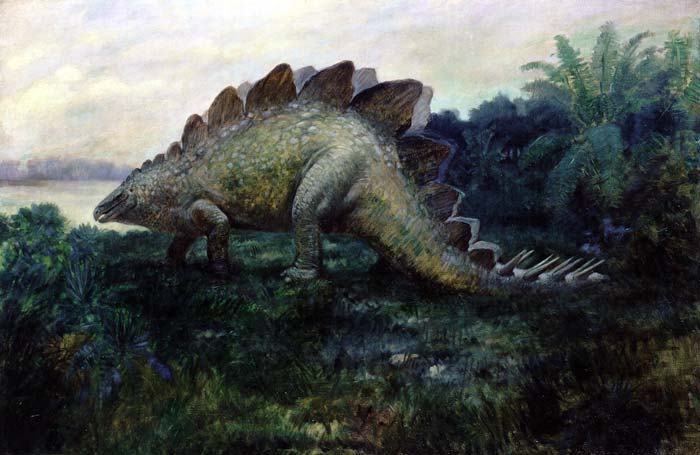

As a child I can recall stegosaurus being my favorite dinosaur. I had an orange and red hollow plastic stegosaurus that was my buddy.
One of the more recognizable dinosaurs, stegosaurus (meaning roof lizard) has a distinct spiked tail and large plates on its back (more on those later). About the size of the bus, this herbivore used its aggressive appearance as a defense.
While it is still up for inquiry, some believe the plates on the stegosaurus' back helped cool the dinosaur. The large surface area would help the most amount of skin come in contact with the wind.
I like this idea the best, it would mean the stegosaurus was the prototype for modern day refrigeration equipment. Simply put, the hot gas travels through a coil that has fins attached to it (all to increase the surface area of a given space), and as the gas is exposed to more and more wind it releases its heat. Its amazing how many intricate and detailed systems we create are just innovations on what already exists in nature.
Sources: Stegosaurus Fact sheet at Enchantedlearning.com
Wikipedia
Sunday, December 19, 2010
Troodon

On Des's favorite tv show, Dinosaur Train, the Troodons (pronounced TROH-o-don), operate the train. Lacking modesty, the Troodons constantly proclaim themselves as the smartest dinosaurs.
This is because fossil records show that the Troodon had the largest brain according to its body size. Scientists think the Troodon was about as smart as modern day birds.
Troodons lived in North America in the late Cretaceous period, about 70 million years ago.
Troodon was a carnivore, with sharp teeth and a toe claw. Not as big as the Deinonychus's toe claw, but still deadly. Troodon was a bipedal theropod, who probably ran very fast.
Some paleontologists theorize that Troodon was nocturnal because of their large eye sockets.
Troodon on Dinosaur Train:

Sources: http://www.enchantedlearning.com/subjects/dinosaurs/facts/Troodon/
Dinosaur Train
Thursday, November 25, 2010
Lambeosaurus (Lam-bee-oh-sore-uss)
It's been a crazy couple of months. I went from super pregnant to now trying to figure out how to take care of an infant and a 2.5 year old. I do hope to post regularly someday soon.

Lambeosaurus was a large Hadrosaur. They lived in the late Cretaceous period in North America.
Lambeosaurus was an herbivore. They had a large crest on their head that looked like an axe. Some scientist believe that the crest was used to make sounds so they could communicate with each other.
Check out how big the Lambeosaurus was:

Sources:
http://en.wikipedia.org/wiki/Lambeosaurus
http://www.kidsdinos.com/dinosaurs-for-children.php?dinosaur=Lambeosaurus
http://www.atomicthinktank.com/viewtopic.php?f=14&t=20940&start=3585
http://commons.wikimedia.org/wiki/File:Lambeosaurus_magnicristatus_DB.jpg
Thursday, October 14, 2010
Elasmosaurus.
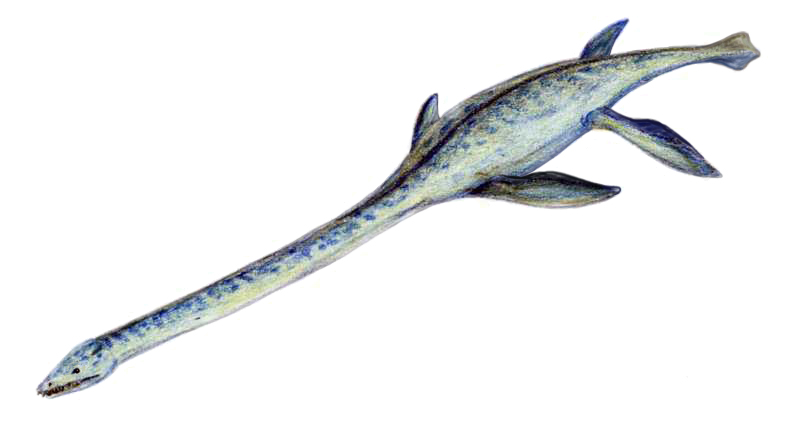
I am deciding to dive into the ocean for my first post and introduce everyone to the elasmosaurus! There is a character in the show Dinosaur Train named Elmer, and he is an elasmosaurus who they meet on their underwater adventure.
This dinosaur is half neck and has 71 vertebrae, more than any other animal. Elasmosaurus is a plesiosaur who lived in the late Cretaceous period. At 45' they were about the size of a shipping container, and weighing in around 9000 pounds.
Due to their large size, it was thought that they used their long necks to stalk and prey on schools of fish, rather than engaging in a chase.
Sources: Wikipedia, About.com
Subscribe to:
Posts (Atom)